

Theatre@41 (ISO 3382 - 1)
<!--
Work info
-->
Client:
Theatre@41
Role:
IR Measurement
Year:
2025
Project Brief
To capture the acoustic signature of a black box studio theatre for remote musician monitoring, I recorded spatial impulse responses (IRs) at key performance positions. This work enables musicians performing in separate spaces to experience the theatre's acoustics through their in-ear monitors, creating an immersive perspective simulation for enhanced ensemble cohesion.
Signal Chain & Setup
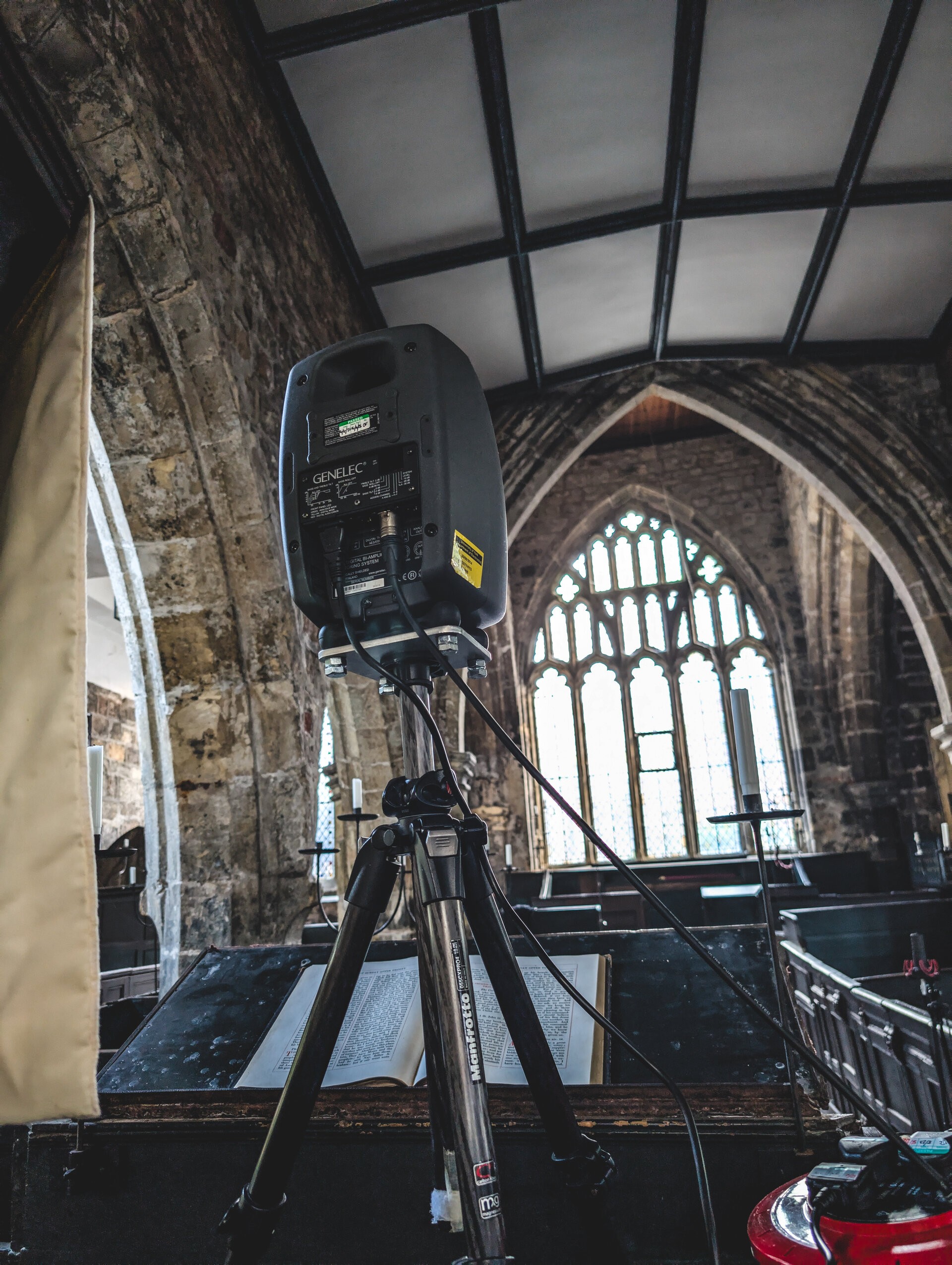
A Soundfield ST450 Ambisonic microphone (B‑format) was positioned at musician ear height across different stage locations, while Genelec studio monitors reproduced the test stimulus. Precise speaker‑to‑mic alignment and gain staging ensured the theatre's controlled noise floor remained well below the sweep level. Key gear highlights:
Microphone: Soundfield ST450
Speakers: Genelec nearfields
DAW: Reaper
Analyses: MATLAB
Measurement Process
Exponential sine sweeps (ESS) were generated in MATLAB, each 30s long to maximize signal‑to‑noise while respecting the intimate theatre environment. Post‑recording processing used custom MATLAB scripts for time‑reverse deconvolution, windowing and channel rotation, producing clean, high‑resolution IRs optimized for real‑time convolution in IEM systems. Main processing steps:
ESS generation → recording → FFT based deconvolution
Trim & window tails to emphasize direct sound and early reflections crucial for spatial awareness
Outcomes & Applications
The resulting IR set authentically captures the black box's controlled acoustics, revealing the interplay between absorptive treatments and hard surfaces that define the space's character. These files now serve as:
Real‑time convolution processing for musician IEM feeds
Spatial reference data for remote performance applications
Future iterations will explore capturing IRs during different stage configurations to accommodate the theatre's flexible setup requirements, expanding the acoustic palette available to remote performers.