

Room Acoustics (ISO 3382-1)
<!--
Work info
-->
Client:
Holy Trinity Church
Role:
IR measurements
Year:
2025
Acoustic Fingerprinting for Performance Preparation: Capturing a 13th-Century Church
Project Overview
This project captured the acoustic signature of a 13th-century church in York, creating spatial impulse responses (IRs) that serve both heritage preservation and practical performance preparation. The resulting acoustic fingerprints enable touring actors and musicians to experience authentic venue acoustics before arrival.
Technical Approach
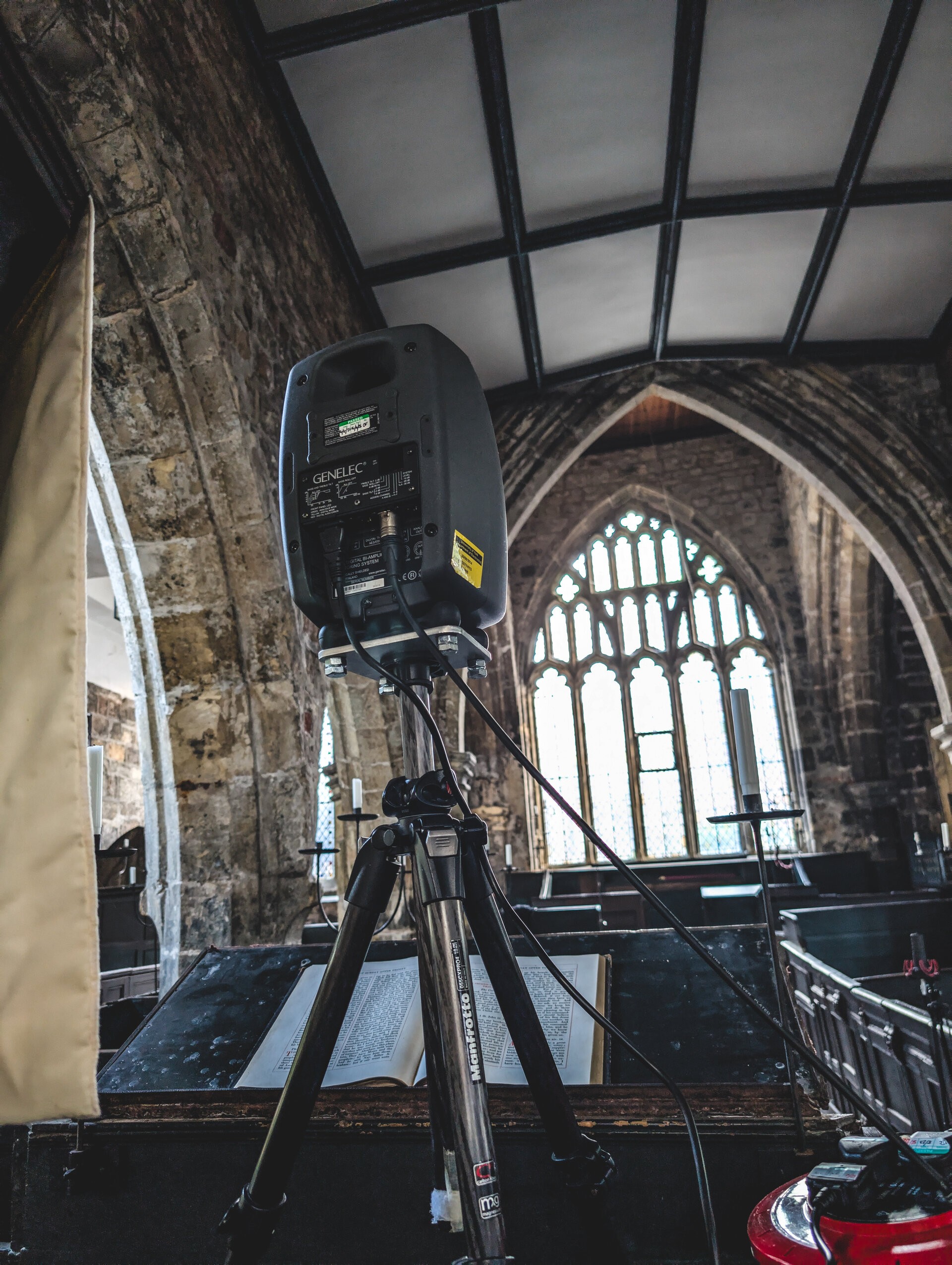
Using a Soundfield ST450 Ambisonic microphone positioned at three listener-relevant locations, I recorded 30-second exponential sine sweeps through Genelec monitors. The B-format capture at ear height preserved the full spatial character of the nave's acoustics.
Processing Workflow
MATLAB-generated ESS signals optimized for signal-to-noise ratio
FFT-based deconvolution with custom scripts
Time-domain windowing to isolate direct sound and reverberant decay
Channel rotation for spatial accuracy
Performance Applications
The IR library enables performers to rehearse with venue-accurate acoustics through convolution processing. Actors can preview how their voice will carry in the space, while musicians can adjust their playing style to suit the church's natural reverb characteristics. Testing with anechoic recordings convolved with these IRs showed significant improvement in performers' spatial understanding and confidence.
Key Benefits
Pre-tour acoustic familiarization for visiting performers
Authentic spatial context for remote rehearsals
Heritage preservation of historic acoustic spaces
Reference data for venue comparison studies
Impact
This acoustic fingerprinting method bridges the gap between technical documentation and artistic preparation, giving touring performers crucial spatial awareness before they step into unfamiliar venues. The approach has proven particularly valuable for period-appropriate performance preparation in historic spaces.